Hardscaping in Charleston
Palmetto Landscape is a hardscape company as much as a landscape one. We build patios, driveways, walkways, retaining walls, fire pits and the drainage that keeps them dry, then lay the sod, cut the beds and plant around them, so a backyard renovation runs with one crew and one price from the first stake to the last load of mulch.
We lay Belgard, Tremron and Lowcountry Paver, or the paver you already have picked out. You see a sketch before we dig, we handle the HOA or Board of Architectural Review paperwork, and we back our workmanship for two years.
- What we build
- Patios, driveways, walkways, walls, fire pits, pool decks, outdoor kitchens, lighting and drainage
- Warranty
- Two years on our workmanship
- Approvals
- HOA and BAR paperwork handled for you
- You hear back
- The day you call
Hardscape services, from one patio to the whole backyard
Four jobs make up most of the hardscape work in Charleston yards. Each one has its own page with the detail.
The rest of a backyard renovation
Anything outside our own trades goes to a subcontractor we trust with it. You still deal with us, and we answer for the finished job.
Pavers, brick, stone and shell: what suits a Lowcountry yard
The material you pick sets the look, the price range and how the job copes with salt air, oak roots and standing water.
The paver makers only honor their product warranties when the pavers go down to industry installation guidelines. We build to them on every job, which keeps that coverage in place for you.
A backyard renovation, from site visit to cleanup
- Site visit and a price. We walk the yard with you, measure, and send the number the same day.
- A sketch. We draw the layout or mark it out on the ground with paint and stakes, so you can stand where the patio will be before anybody digs.
- Approvals. We put together what your HOA or the Board of Architectural Review asks for and submit it. If a protected tree is involved, that permit comes first.
- 811. South Carolina law requires a locate request three full business days before digging. We file it, and the utilities mark their lines for free.
- Base. We dig out, lay gravel and compact it in layers: four to six inches under patios and walks, eight to twelve under driveways.
- Build. Pavers, walls, fire pit and lighting runs, in the order the job needs them.
- Grade, sod and beds. We set the soil to fall away from the new work, lay the sod, and cut and plant the beds. Paver-only crews leave that part to you.
Our workmanship warranty on hardscape. If a paver sinks or a wall shifts because of how we built it, we come back and fix it.
A whole backyard, from the first day to the last.
Why the patio and the lawn should come from one crew
A paver crew builds the patio and leaves you a ring of torn-up dirt where the lawn used to meet it. A landscaper hires the patio out and lets somebody else set the grade. Either way, the rain that runs off the new hard surface lands on ground nobody on site answers for.
We build both, so we grade the patio and the lawn around it as one surface and send the water away from the house. We also keep more than a hundred Charleston properties on a two-week cycle. If we look after your lawn too, we see how the patio handles its first summer on every visit.
- Based
- North Charleston, SC
- On our route
- More than a hundred properties, every two weeks
- Outside our trades
- A subcontractor we trust, and you still deal with us
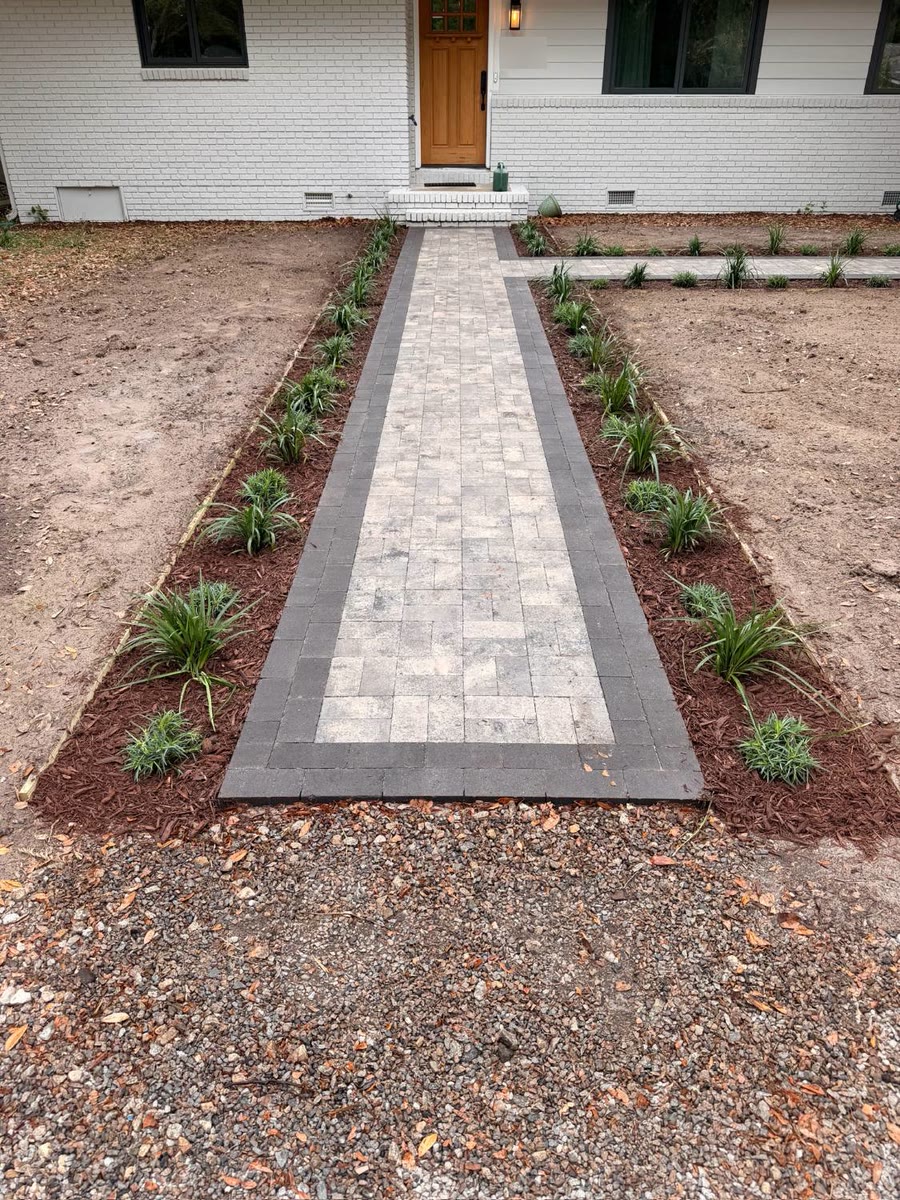
A paver front walk in Summerville
Charcoal border, pale field, and a branch that runs along the front of the house. We cut, planted and mulched the beds on both sides the same week.
Hardscape and planting on one job, by one crew. More on walkways.
Permits, HOAs and historic district review for hardscaping
Downtown, the city reviews hardscape. The Board of Architectural Review adopted a hardscaping policy in December 2025 for the Old and Historic District, the Old City District and the landmark districts. City preservation staff handle most of those reviews without the full board. The policy rules out asphalt and plain poured concrete driveways, prefers pervious paving, and bars concrete worked to look like brick or stone. It also asks owners to keep paving to what the driveway needs plus a limited area for use. We put your site plan and materials in front of staff before we order anything.
The street end of a driveway belongs to somebody else. In the City of Charleston, a paver or brick apron in the public right of way counts as an encroachment and needs the city’s application. On a state road, you request a new apron through the local SCDOT office. The driveway page covers both.
Trees and HOAs come first. Charleston County protects trees 24 inches across at chest height and up, and Summerville wants a permit from eight inches. HOAs across Mount Pleasant, Daniel Island and Summerville expect to approve a patio or a driveway before it goes in. We put the HOA package together with you, so the approval sits in the schedule instead of stopping it.
- Where we build
- Charleston, North Charleston, Mount Pleasant, James Island, Johns Island, West Ashley, Daniel Island, Summerville, Hanahan and Goose Creek.
Hardscaping questions Charleston homeowners ask us.
What is hardscaping?
The built parts of a yard: patios, driveways, walkways, walls, fire pits, steps and the drainage under and around them. Landscaping covers the living parts, the lawn, beds and trees. We do both, so on our jobs the lawn meets the patio edge with no strip of bare dirt between.
What is the best material for a driveway in Charleston?
Pavers give you the strongest look and a surface you can lift and relay. Concrete costs less up front outside the historic districts. Gravel, plantation mix and crushed oyster shell cost the least and drain best, but they need an edge and a top-up now and then. Downtown, the city does not allow asphalt or plain concrete driveways.
Do I need a permit or HOA approval for hardscaping?
Often. Inside Charleston’s historic districts, city preservation staff review hardscape. A new driveway apron needs the city’s encroachment application in the City of Charleston, or a request to SCDOT on a state road. Most HOAs want to approve a patio or driveway too. We handle the HOA and BAR paperwork and check your address before we quote.
How long does a paver patio take?
A straightforward patio takes a few days, and the base is most of the work. Fire pits, seating walls and steps add time. You get the schedule with the price.
Do you warranty hardscape work?
Yes. We give two years on our workmanship: if a paver sinks or a wall moves because of how we built it, we fix it. The pavers carry the maker’s warranty on top, lifetime and transferable from Belgard and 25 years from Tremron, both on residential work laid to industry guidelines.
Which paver brands do you install?
Belgard, Tremron and Lowcountry Paver, or another paver you have picked out. Bring a brochure or a photo and we price that one.
Can you redo a whole backyard?
Yes. Patio, walls, drainage, lighting, irrigation, sod and beds, planned together and built in the right order. Anything outside our own trades goes to a subcontractor we trust, and you still deal with one company.
Why do pavers sink?
Pavers sink when the base under them is thin, loose or wet. We compact four to six inches of gravel in layers under a patio and eight to twelve under a driveway, as the paver industry’s guidelines call for, and we set an edge restraint so the border holds its line.
Send the yard, take the price.
Photos of the space, rough measurements and what you want in it. That is enough for a real number the same day, before anyone digs.